South Africans are voting today, and many people want to know one thing. Where can you see the voting results without stress? The good news is that it is easy to follow the SA elections 2026 count online. You do not have to wait for the late news bulletin. A few simple steps are all you need.
This guide explains where to find the SA election results, how to read them, and what to expect from this round of local government elections.
Local government elections 2026 are under way
The local government elections started on Monday, 2 November 2026, with special voting. Special votes continued on Tuesday, 3 November. The main voting day is today, Wednesday, 4 November 2026.
President Cyril Ramaphosa announced the date earlier this year. According to the Electoral Commission, these are the sixth local polls since democracy. They are also taking place at a time when politics at home and abroad is changing fast.
Here is a simple overview of the key dates.
| Voting stage | Date |
|---|---|
| Special voting, day one | Monday, 2 November 2026 |
| Special voting, day two | Tuesday, 3 November 2026 |
| Main voting day | Wednesday, 4 November 2026 |
The numbers behind municipal elections 2026
The scale of these municipal elections 2026 is large. The Electoral Commission (IEC) says 136 790 candidates met the legal requirements to take part. Earlier, more than 140 000 candidates were nominated for 10 526 council seats. That is a big jump compared with the 2021 polls.
Special voting also broke a record. The IEC approved 2 655 067 special vote applications. That is a 131% rise from the 1 147 759 applications approved for the previous local elections.
On election morning, the IEC reported a smooth start. By 7am, 98% of the country’s 23 696 voting stations were open. The commission urged all registered voters to use the remaining hours to cast their ballots.
Where to follow the SA election results online
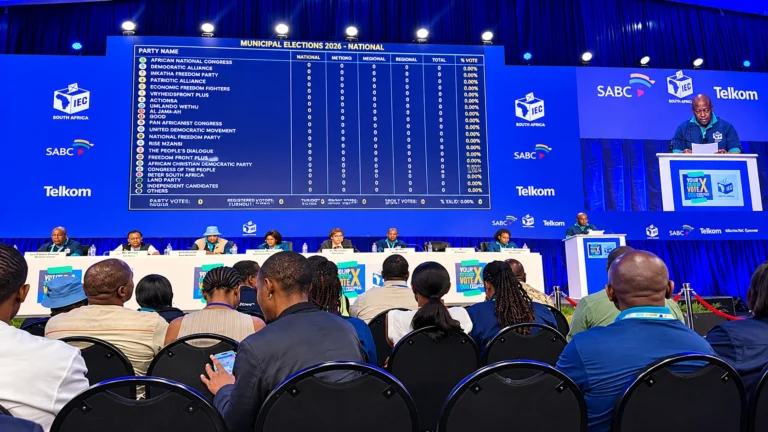
Once the stations close, the counting begins. The SA election results will then appear in stages. Here are the simple options.
1. The official IEC website. The Electoral Commission runs the process, so its results pages are the best place to confirm the final numbers. Make this your first stop if you want the official picture.
2. The Newsday election portal. Newsday has built a dedicated portal to track the 2026 local elections 2026 results as they come in. It is easy to use. The portal holds election data going back to 1999. This makes it easy to see how support for each party has changed over the years.
The portal covers results for municipalities, provincial legislatures and the national assembly. It also has an interactive map. You can zoom in on your own area and view the vote results for your municipality. The portal is updated as the south africa election results arrive, so you can simply refresh the page.
3. News channels and websites. Many people also watch enca news and other broadcasters for live updates on the night. Radio stations and news sites will share the count too. It is a good idea to compare what you see with the official figures.
Why the IEC results system matters
Trust in the count matters. Earlier in October, the IEC completed an independent external audit of its Election Results System. The commission said the audit is part of efforts to keep the process transparent and credible.
There was also some controversy before the polls. The MK Party claimed that a two hour outage of the IEC results dashboard in the past was linked to the manipulation of results. The IEC rejected this. It said the party had not produced evidence to back up the claim.
For voters, the lesson is simple. Use official sources and be patient. Early numbers can change as more voting districts report.
What analysts expect from south african elections 2026
Nobody knows the final outcome yet, so treat predictions with care. Still, analysts have shared some views.
Louw Nel, a senior political analyst at Oxford Economics Africa, said support for the ANC could fall to between 31% and 34%. He linked this to a sharp drop in support in the biggest cities. In those metros, he expects the Democratic Alliance to dominate.
This is a forecast and not a voting results south africa update. The real numbers will come from the count.
Coalitions are back in the spotlight
If no party wins more than half the seats, councils must form coalitions. Some welcome the idea of change. Others warn about the downsides of deals made behind closed doors.
Yunus Chamda of the Joburg Crisis Alliance pointed to a key problem. Under the current rules, parties are left to negotiate coalitions among themselves. He said this can give small parties too much power. It can also let politicians dodge accountability.
Johannesburg is a clear example. The city has had seven mayors since 2021. Its last two mayors came from a party that held only 3 of the 270 council seats. Chamda said this has created huge instability. He added that when residents confront parties, they can simply blame the coalition.
Shifting alliances and a revolving door of mayors have also been linked to worsening services and financial decline in the city. So when the sa voting results come in, the real story may only start after the count. Watch for the coalition talks that follow.
How to read the sa voting results the easy way
Results screens can look busy. Here are a few simple tips.
- Check the percentage counted. Early results only show part of the picture.
- Look at your own ward. Local polls are about local councillors, so your ward matters most.
- Compare with past years. Historical data helps you see whether a party is growing or shrinking.
- Wait for the official declaration. The IEC makes the final call.
These steps make voting polls south africa coverage much easier to follow. They also help you avoid sharing wrong numbers on social media.
When are national elections in South Africa?
Many readers ask this question during local polls. The last national vote was held in 2024. The next national elections South Africa will hold are due in 2029. Today’s vote is not a national poll. It decides who runs your municipality.
Still, the outcome will be watched closely. Strong or weak showings in the metros could shape the mood ahead of the national elections south africa in the years to come. That is why so many people are following the elections south africa coverage so closely.
Why your vote and the count both matter
Local councils decide on things you see every day. These include water, roads, refuse removal and electricity connections. That is why the votes in south africa today matter so much for ordinary households.
It is also why watching the count is worthwhile. When you follow the south africa voting results from reliable sources, you can hold your new council to account. It is a simple habit with a big payoff.
Quick recap for readers
- Special voting took place on 2 and 3 November 2026.
- The main voting day for the south africa elections 2026 is 4 November.
- The IEC is the official source for the south africa election results.
- Newsday’s portal offers an easy way to explore results by area and compare them with data since 1999.
- Analysts say the ANC could drop to between 31% and 34%, but this is only a forecast.
- Coalition talks could decide who runs the big cities.
The sa elections are a major moment for Africa’s most industrialised economy, and the count will take time. Use the official channels, stay patient and check back often. If you want the full process explained, the SAnews report on the election day start is a good place to begin.
About the Author