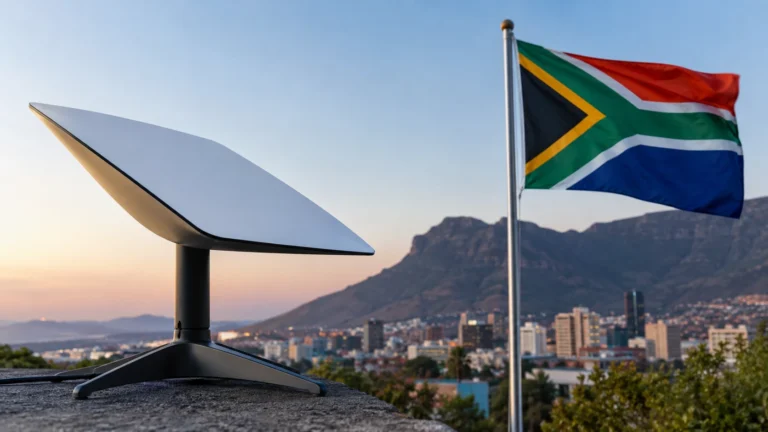
Thousands of South Africans who relied on Starlink for fast internet are now losing their connections. The satellite company has started shutting down accounts that were used in the country without approval. For many people in rural areas, this is more than a small inconvenience. It was often their only reliable way online.
The cut offs come while a bigger fight over licensing rules remains unsolved. Until that is settled, an official Starlink launch in South Africa is nowhere near.
What is happening to Starlink users?
Starlink has been disconnecting South African accounts that used the service through international roaming plans. Many users bought these plans through resellers in neighbouring countries, then used the dish at home in South Africa. It was a simple workaround, and it worked for a while.
Affected customers have received notices saying South Africa is not an approved service location. They were told to cancel their subscriptions or move their equipment to a country where Starlink is allowed to operate.
Starlink’s own rules say roaming plans are meant for temporary travel, not permanent use in one place. That is why the company can end these accounts easily, and why users have little room to argue.
Why is Starlink not allowed in South Africa?
The main problem is ownership. Under South African law, a company that wants an individual electronic communications network licence must be at least 30% owned by historically disadvantaged groups. Starlink’s parent company, SpaceX, has not agreed to meet this rule.
The regulator, the Independent Communications Authority of South Africa (ICASA), has said all telecoms companies must follow the same rules. In its view, there is no special lane for Starlink.
Local officials also made it clear a few years ago that using Starlink through roaming plans was not legal. Even so, many homes, farms and small businesses kept using it. For them, a stable connection was worth the risk.
The equity equivalent plan
There was a moment of hope. In December 2025, Communications Minister Solly Malatsi told ICASA to consider recognising equity equivalent investment programmes. These allow a foreign company to invest in local development instead of handing over shares.
Starlink backed this idea. The company proposed spending about R500 million to connect 5,000 schools with free internet and equipment. It also spoke about investing roughly R2 billion in local infrastructure, such as ground stations, power, fibre and staff.
On paper, it looked like an easy compromise. South Africa would get investment, and Starlink could get its licence.
ICASA says the law must change first
The plan hit a wall in May 2026. ICASA said it could not fully apply equity equivalent programmes under the current Electronic Communications Act. In its view, only a change in the law could allow it.
A day earlier, Minister Malatsi had told Parliament that government would amend the Act to allow these programmes next to ownership rules. So the regulator and the minister agree on where the problem lies, but changing a law takes time.
In June 2026, ICASA went further. It said satellite operators such as Starlink cannot get a network licence at present. The most realistic way in, according to the regulator, is to buy a licence from a company that already holds one.
ICASA is also working on a new licensing framework for satellite internet operators. It says the goal is to expand access in remote areas and bring down costs. That framework is still being developed.
Key moments at a glance
| When | What happened |
|---|---|
| December 2025 | Minister Malatsi directs ICASA to consider equity equivalent programmes |
| April 2026 | ICASA says it is developing a new satellite licensing framework |
| 12 May 2026 | Minister tells Parliament the law will be amended |
| 13 May 2026 | ICASA says it needs a legal change before it can act |
| June 2026 | ICASA says satellite operators cannot get a network licence for now |
Who is hurt the most?
The people hit hardest are those with few other choices. In towns and villages where fibre has not arrived and mobile signal is weak, Starlink offered speeds that were hard to find elsewhere. Farmers used it to run their businesses. Families used it for school work, banking and video calls.
Now these users face a tough choice. They can move back to slower options, wait and hope for a legal route, or look at other satellite and wireless providers that are licensed locally.
There is also a safety point. Anyone who keeps using a roaming account risks a sudden shutdown with no warning. Buying a dish from a reseller who promises “guaranteed” service in South Africa is risky, because Starlink can switch the account off at any time.
What should South Africans do now?
The simple advice is to check before you buy. If you already own a dish, read the notice from Starlink carefully and follow its instructions. If you are thinking of buying one, know that the service is not legally available in South Africa today.
You can follow updates from the regulator and from the Department of Communications and Digital Technologies. Both publish official notices when rules change.
If you need internet in a remote area, look at licensed local options. They may cost more or run slower, but they will not be cut off without warning for breaking the rules. It is also worth asking providers about rural coverage plans, as some are expanding.
What could happen next?
Three things will decide the future of Starlink in South Africa:
- Law change: Parliament would need to amend the Electronic Communications Act. That process includes drafting, public comment and debate.
- Licensing framework: ICASA’s new rules for satellite operators could show a clearer path.
- Company decisions: Starlink could decide to meet the ownership rule, or buy an existing licence, as ICASA has suggested.
None of these steps is quick. Anyone who promises a firm launch date is guessing.
The bottom line
The latest Starlink cut offs show how stuck this issue has become. The company wants to enter the market on its own terms. The regulator says it must follow the existing law. The minister wants the law changed. Meanwhile, ordinary users are the ones losing their internet.
For now, the message is simple. Starlink is not an approved service in South Africa, and unofficial access is closing fast. Whether that changes depends on lawmakers, the regulator and the company itself. Until they agree, many South Africans in remote places will keep waiting for a better connection.
About the Author