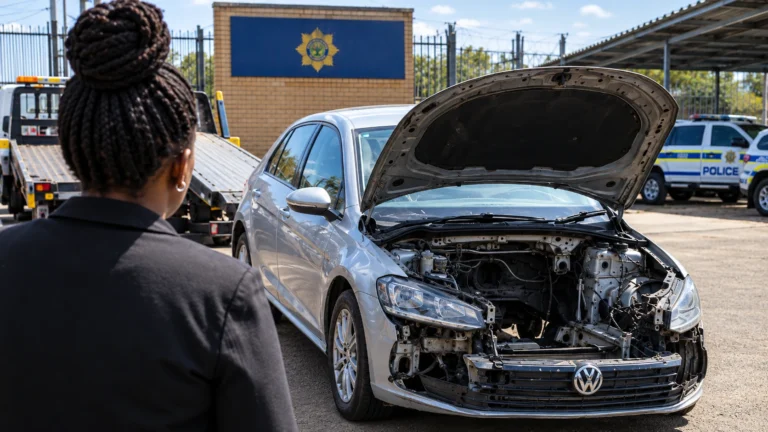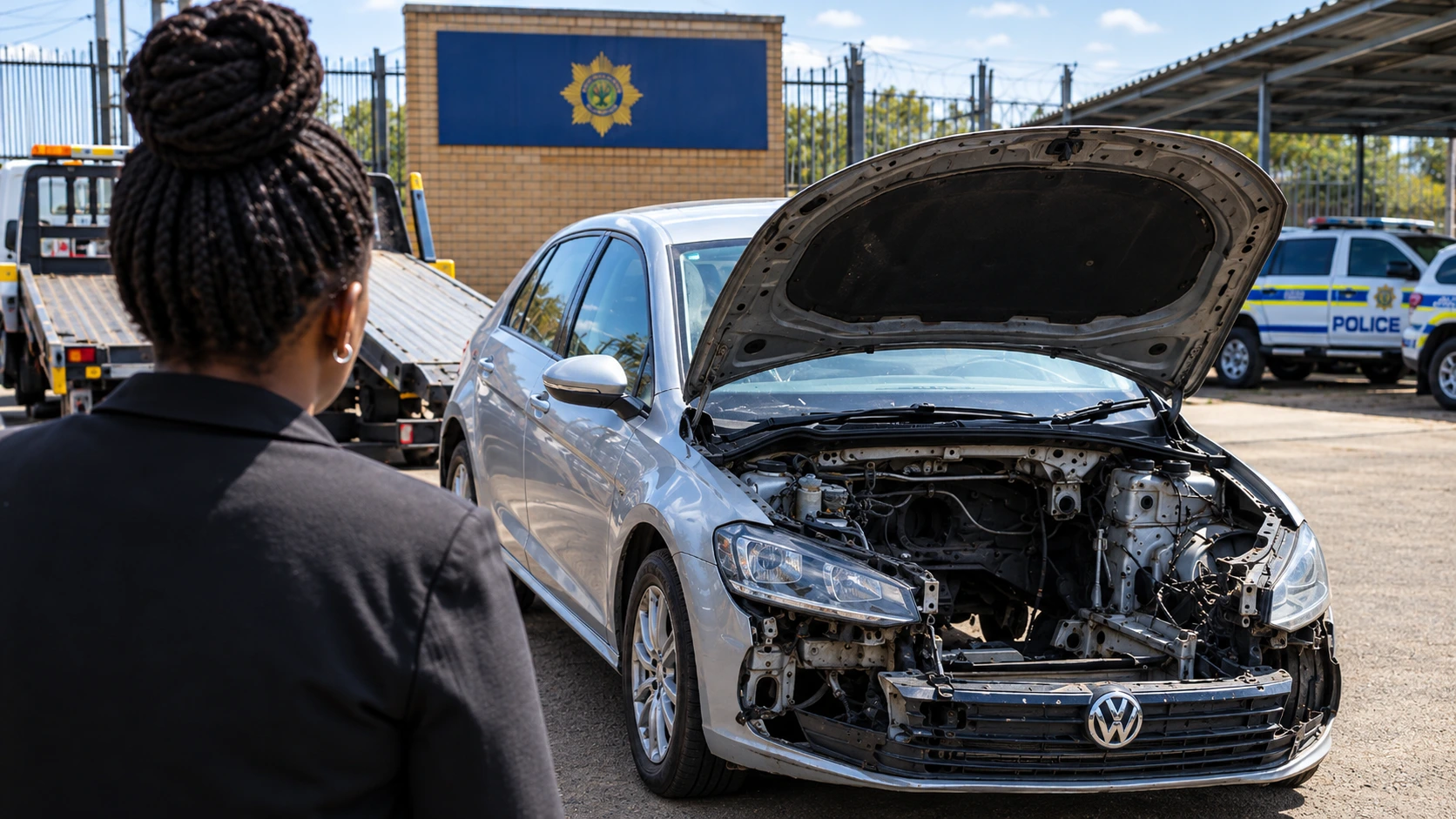
Imagine handing your car over to the police and getting it back without an engine. That’s what happened to one Pretoria woman, and a judge has now said the Minister of Police must pay for it. The ruling also tore up a form she signed on collection, one the police hoped would protect them.
The ruling in short
The Gauteng High Court in Pretoria found that the South African Police Service (SAPS) didn’t look after a 2014 volkswagen golf belonging to Suzette Ropafadzo Paradza. The car was held as an exhibit at the SAPS 13 storage facility in Pretoria West.
Acting Judge Jacques Minnaar said the police had a duty of care. The car went in with an engine. It came out without one. The court also refused to enforce the indemnity Paradza signed, so the police couldn’t hide behind it.
How much she’ll get is still unknown. The judge postponed that question, so the damages will be decided in separate proceedings. For now, the Minister must pay whatever she manages to prove, plus the costs of the application.
How a borrowed car ended up in police hands
The trouble started in May 2022. Paradza’s husband, Selestian Osiele, had bought the car around 2019 or 2020 and given it to her. He then lent it to a friend called Ellen. Ellen allegedly made up a hijacking story, and police took the car in as part of their investigation.
Warrant Officer Warren Timothy Bishop was the investigating officer. He told the court he found the car in Laudium on 24 May 2022. It had no battery, he said, but it ran and it had its engine. A security officer at the facility, Mogadi Mashap Mashala, agreed the car was booked in with the engine fitted.
So far, easy enough. Then came collection day.
Collection day went badly
In September 2022, Paradza and Osiele arrived to pick up the car. They struggled to find it. Nobody could hand over the keys. In the end, they had the car towed to a mechanic in Pretoria West.
Osiele told the court what the mechanic found. The bonnet was held shut with wire, and the engine was gone. He phoned Bishop to report it, then took the car back to the police facility.
That’s where the paperwork gets messy.
Far more than an engine
Paradza’s expert, Albert Chibuike, looked at the car about three years after police first took it. The engine wasn’t the only thing missing. He listed the gearbox, water pump, flywheel, alternator, starter and manifold as removed or tampered with. The cooler, regulator fan and catalytic converter were gone too, and the bumper had been pulled off.
Chibuike estimated that stripping the car would take one to two days. He didn’t think a specialist had done it. The judge didn’t treat his evidence as formal expert testimony, but still accepted his 29 years in the industry and his view on how long the job would take.
When the dates didn’t add up
Police records didn’t line up neatly. Warrant Officer Kenneth Benjamin Brauns testified that the car was booked back into the system on 5 September 2022, already missing its engine and gearbox. But he admitted he couldn’t say when it physically came back. He’d been following instructions from Captain Hoskins, who never testified.
The judge settled on 1 September 2022 as the real return date. A delay in capturing it on the system could explain the gap.
| When | What happened |
|---|---|
| May 2022 | Police take the car into custody |
| 24 May 2022 | Bishop recovers it in Laudium, engine fitted |
| 1 September 2022 | Car returned to storage without an engine |
| 5 September 2022 | Return recorded on the police system |
| About three years later | Expert inspection finds many parts missing |
Why the police were at fault
The court’s reasoning here is simple. When police seize or hold someone’s property, they take on responsibility for it. That property may have to go back to its owner once a criminal case no longer needs it. So it has to be kept safe.
The judge found the volkswagen golf had an engine when it was taken and none when it was returned. The police, the judgment said, clearly failed to keep it safe until it could be released to Paradza.
The judge wasn’t impressed by the way staff at the facility handled members of the public either, calling their attitude lax. There was another detail that stood out. The officer who filled in the release forms and issued the exit permit never physically inspected the car first. A quick look would’ve been an easy thing to do.
The indemnity that didn’t hold
When Paradza collected the car, she signed an indemnity. It said she’d received the vehicle in good condition and tried to protect the police and the state from any claims or losses linked to it.
Warrant Officer Ronald Malesela Mashiachidi handled the release documents. He told the court he explained them to her, and she signed both the release record and the indemnity. The judge accepted the wording was clear and that nobody forced her to sign.
But the judge didn’t stop there. Using the Constitutional Court’s decision in Barkhuizen v Napier, the court asked whether enforcing the indemnity would be fair and in line with public policy and constitutional values. You can read about that court on the Constitutional Court website.
The answer was no. Paradza had come for her own property, got very little help and was handed documents to sign. The court said she wasn’t on equal footing with the officials in front of her. Holding her to the indemnity, the judge said, would be unfair and unjust.
What car owners can take from this
This ruling doesn’t rewrite the law. Still, it shows that a signature on a form isn’t always the end of the story. If you ever collect a vehicle from police storage, a few simple habits help. Look the car over properly before you sign anything. Take photos of the outside and inside. Ask questions if something seems off, and keep copies of every page you’re given.
None of this is legal advice, and every case turns on its own facts. If your property was damaged while in police custody, speaking to an attorney is a sensible move. General information about the police is on the SAPS website.
What comes next
Paradza has won on liability, but the money question is still open. No date has been set for the damages hearing.
The case also fits into a bigger conversation about police accountability. People hand over cars and other belongings during investigations and expect them back in one piece. This judgment says the state has to honour that expectation, whether the car is a volkswagen golf or anything else.
After years of waiting, this is a real win for Paradza. And for everyone else, it’s a clear reminder that when police take your property, looking after it is their job.
About the Author