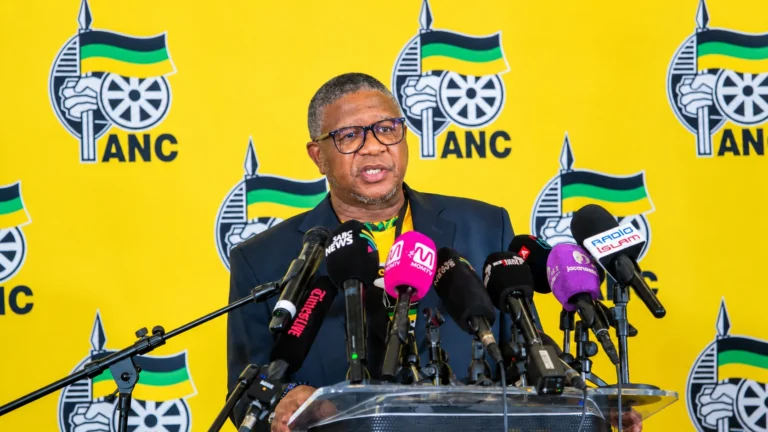
The Electoral Commission of South Africa (IEC) has made a major call on the candidate row. It says the Constitutional Court ruling in the ANC’s favour will also help other parties that were left out in the same way.
What the IEC announced
Speaking at a media briefing on Friday 16 October, IEC chairperson Mosotho Moepya said the commission will include 32 political parties that were in the same position as the ANC. These parties uploaded their candidates and paid their deposits. They just did not complete the final submission step.
Moepya said it would be unfair, and even irrational, to leave them out. He pointed to the principle of parity of treatment, which means similar cases must be treated the same way.
The IEC will now contact each of the 32 parties. It wants to confirm whether they still plan to contest the 4 November local government elections. This work will be done within a shortened period and will involve only the affected parties, including the ANC.
How the dispute started
The row goes back to the candidate nomination deadline of 28 August. The ANC uploaded its candidate details and paid the required deposits on the IEC’s online nomination system. However, it did not complete the last step, which was to click the button that marks the submission as final.
The IEC treated that step as compulsory. It rejected the nominations in six municipalities. In Port St Johns and Ngquza Hill, this left the ANC with no candidates at all.
The ANC argued that the final click should not be enough to wipe out the rights of candidates and voters. The Electoral Court disagreed and backed the IEC on 16 September. The ANC then took the matter to the Constitutional Court.
What the Constitutional Court decided
On Thursday 15 October, the Constitutional Court ruled by majority in the ANC’s favour. It set aside the Electoral Court decision. It also ordered the IEC to take all necessary steps to place the affected ANC candidates and lists on the ballot papers.
The ruling covers 181 candidates. Of these, 130 are proportional representation candidates and 51 are ward candidates. The court said it would give its full reasons at a later stage. It also held back its decision on costs.
The IEC’s chief electoral officer, Sy Mamabolo, said the commission would respect the order in both letter and spirit. He also gave an early reading of the judgment. In his view, the court appeared concerned that the final click was given more weight than constitutional rights.
From “ANC only” to “all similar parties”
This is where the story took a turn. Soon after the judgment, the IEC signalled it would apply the order only to the ANC. The reason was simple. Other parties had not gone to court, so the order did not cover them.
Earlier reports said 2,093 candidates from 44 parties were also affected. That led to worries about fairness. Many people asked why one party should get a second chance while others did not.
The IEC has now changed course. Moepya said the commission thought carefully about the wider effect of the ruling. If it excluded parties in the same boat as the ANC, the fairness of the whole election could be questioned. He also said the commission was not intimidated by the ANC and acted within its own mandate.
Not every party gets in
The relief is not automatic for every party. The IEC found that 13 other parties did not meet the requirements for a lawful candidate submission. They remain outside the net, even after the commission widened its approach.
So the line the IEC has drawn is clear. Parties that nominated compliant candidates and paid deposits, but missed the final submission step, are in. Parties that failed the basic requirements are not.
A quick look at the key numbers
| Detail | Figure |
|---|---|
| ANC candidates reinstated by the court | 181 |
| Proportional representation candidates | 130 |
| Ward candidates | 51 |
| Municipalities affected | 6 |
| Other parties now included by the IEC | 32 |
| Other parties that did not meet requirements | 13 |
| Ballots still to be printed | About 6.6 million |
| Election date | 4 November 2026 |
Ballot papers must be reprinted
The practical side of this decision is huge. The IEC said it will reprint ballot papers where needed so the reinstated candidates appear. With about three weeks to go, the commission is racing against the clock. Reports say around 6.6 million ballots are still to be printed.
Moepya said the commission welcomed the clarity the judgment brought. He added that it is time to move forward. The IEC has not said it expects the election date to move.
For voters, the message is easy to follow. The vote is still on 4 November. Your ballot paper may look a little different in some areas, but the process at the voting station stays the same.
Reaction from the parties
The ANC welcomed the judgment. Secretary General Fikile Mbalula became emotional while addressing the media after the ruling. He later received medical attention. He also called for a review of the party’s relationship with the DA in the Government of National Unity, since the DA opposed the ANC’s appeal.
The DA said it respects the court’s decision. It did, however, raise concerns about what the ruling means for future compliance with IEC deadlines and rules. Before the judgment, the party had warned of “absolute chaos” if late submissions were allowed. It argued that electoral rules must apply equally to everyone.
Some observers say the ruling could open a can of worms for the IEC. The extension to 32 parties is the commission’s answer to that concern. It tries to keep the contest level.
Why this matters to South African voters
Local elections decide who runs your municipality. Councillors influence water, roads, refuse removal and community services. If a major party is missing from the ballot in a municipality, voters lose a real choice.
That is why the Constitutional Court ruling matters beyond the ANC. It deals with a basic question: should a technical step in an online system outweigh the right to take part in an election?
The full reasons from the court are still to come. Once they are published, they should make it clearer how electoral bodies must treat strict deadlines and online systems in future.
What happens next
Here is a simple summary of the next steps:
- The IEC contacts the 32 parties to confirm they still want to contest.
- The commission checks and finalises the affected candidate lists.
- Ballot papers are reprinted for the areas that are affected.
- Voting goes ahead on 4 November, as planned.
Parties and voters should watch for further updates from the commission. You can follow official announcements on the IEC website, and read court documents and media summaries on the Constitutional Court website.
The bottom line
The IEC has chosen fairness over a narrow reading of the court order. By extending the ConCourt ruling to 32 political parties, it has tried to protect the integrity of the 4 November local government elections. The coming days will be busy. The commission must contact parties, finalise lists and reprint ballots in record time. For ordinary voters, the key point stays simple. Make sure you know where you vote, take your ID, and use your voice on election day.
About the Author