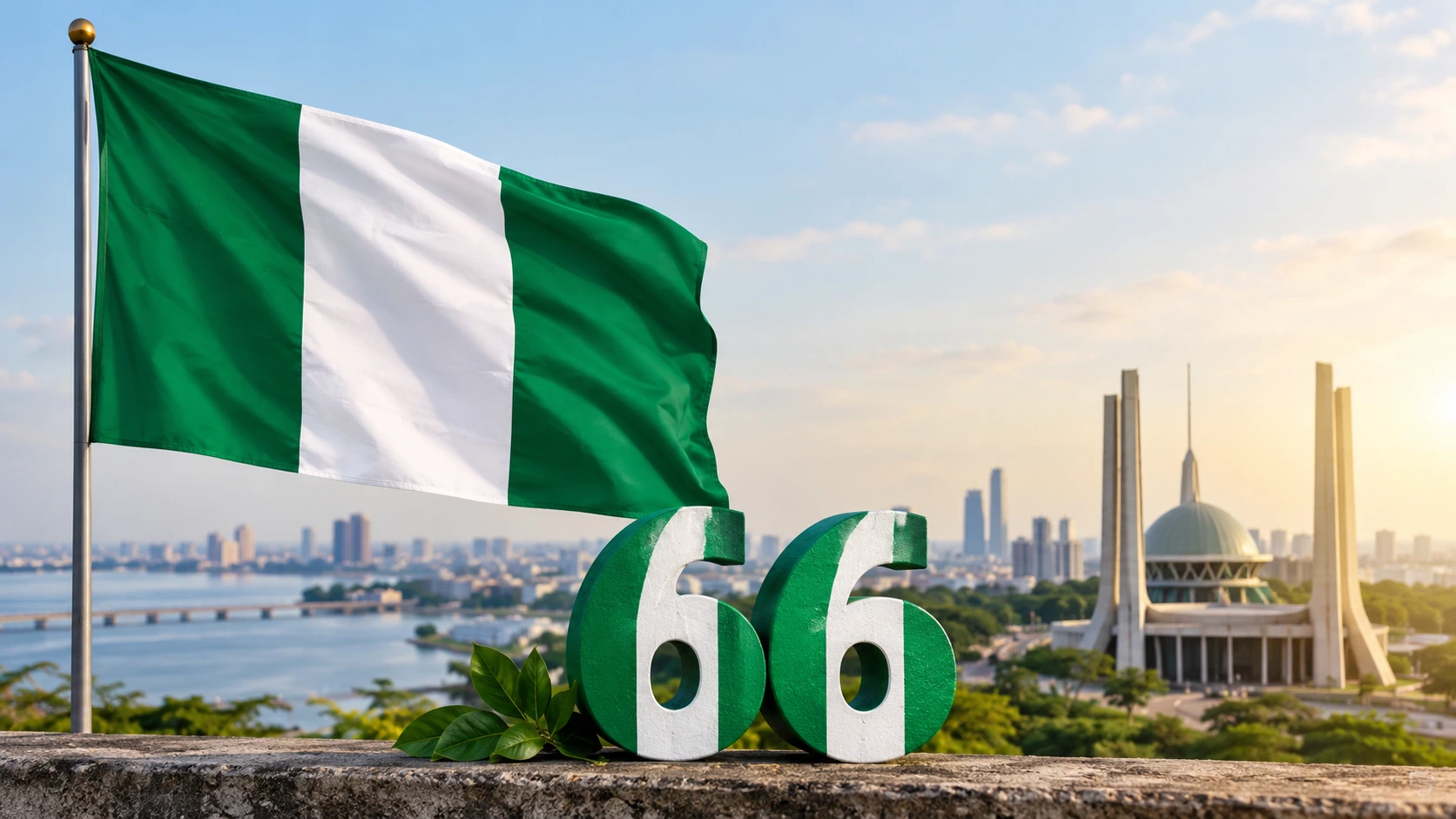
Nigeria turned 66 on 1 October 2026. Birthdays usually bring good wishes. This one has also brought a hard look in the mirror.
A recent opinion column by Dele Sobowale argues that Nigeria has slipped from a hopeful young nation into one weighed down by criminality and poor governance. His case is not easy to read, but it is simple to follow.
Below, we break it down in plain language. This is one writer’s view, so we label his claims as his. It is easy to blur opinion and fact, and we want to avoid that. We have also kept things simple, so you do not need to know Nigerian politics to follow along.
Then and now: the big picture
Sobowale starts in 1960. He says a politician facing a corruption charge back then would not have been picked by a party to run for office. Today, he says, dozens of people accused of serious offences are chasing the top jobs. The accusations he lists include forged certificates, terror financing and drug trafficking.
He also says some former governors accused of serious crimes now sit in the Senate or hope to. In his view, founding leaders like Ahmadu Bello, Nnamdi Azikiwe and Obafemi Awolowo would hardly recognise the country today.
His verdict is blunt. Food, schools, health, roads and governance have all fallen behind where they stood in 1960. In simple terms, he believes the country has moved backwards.
Food: from exporter to importer
The column says Nigeria once fed itself. In 1960, he writes, it was the largest exporter of vegetable oil and the third largest exporter of cocoa. It bought no rice from abroad. Today, he says, it imports both vegetable oil and rice.
He also points to a recent newspaper editorial on fertiliser. According to the federal agriculture ministry, Nigeria uses about 18.6 kilograms per hectare. The target set by the 2006 Abuja Declaration is 50 kilograms. The maths is simple. After twenty years, the country is not even halfway there.
Then comes his sharpest question. What is the use of an educated workforce if the country cannot feed itself? He says Nigerian universities now send more than 120,000 graduates into the job market every year.
Poverty: the numbers keep rising
Sobowale says fewer than 30 percent of Nigerians were poor in 1960, when the population was under 60 million. He adds that the economy was more varied back then.
He then lists the climb. There were about 18 million poor people in the 1960s. The National Bureau of Statistics reported 133 million in 2022. He puts the 2025 figure at roughly 138 million. In simple terms, the number of poor people has grown several times over.
He expects the figure to rise again in 2026. He blames this partly on President Bola Tinubu’s reform plan, which centres on removing the fuel subsidy. To be fair, he also notes that the country is once again working on diversifying its economy. It is not easy to say yet how that will play out. For official figures, the National Bureau of Statistics is the best place to check.
Oil: a bicycle that stopped moving
Sobowale calls the 1970s and early 1980s the golden years. Nigeria was once the sixth or seventh biggest producer and exporter of crude oil. Refineries processed part of the output, and the rest was sold abroad.
He compares the system to a bicycle. It stays upright only while it keeps moving. The idea is simple, and it is easy to see why he chose it. He says the bicycle stopped when regular maintenance at the refineries ended. In his words, no federal government has kept them running since 1994, and they are now scrap.
He also says Nigeria now ranks as the eleventh biggest oil exporter. He notes that crude is now imported from the United States, thanks to the Dangote Refinery. For him, that sums up the damage.
Health: stretched services, thin funding
In the First Republic, he says, regional governments took public health seriously. Patients paid very little at general hospitals. Today, he argues, service has dropped so far that people without money get little help.
He puts the ratio at about 300,000 patients per doctor, which he calls one of the worst in the world. He also cites a February 2026 report in which the health minister said only N36 million had been released from the N216 billion health capital budget for 2025. It is easy to see why equipment ages and staff morale sinks when money does not arrive.
He adds that life expectancy has barely moved in nearly a decade. A September 2026 newspaper report also suggested the 2026 capital budget may not be fully carried out this year.
Jobs and crime
Nigeria’s schools and universities produce nearly half a million graduates a year, Sobowale says. Many finish national youth service with no job. He says criminal networks are ready to recruit them. He names yahoo fraud, romance scams and cross border money laundering. He also says some groups run their operations from inside prison.
It is not easy to follow the news these days, he says, without reading about another case. He adds that law enforcement is falling behind.
Corruption: the heart of the problem
The head of the Economic and Financial Crimes Commission (EFCC) has warned publicly that some officials steal public money constantly. A report on 28 September 2026 said the agency had found officials with very large property holdings.
Sobowale goes further. He calls the public service the biggest crime network in the country. He says the Auditor General’s yearly reports flag questionable transactions running into trillions of naira. He singles out several bodies, including the Central Bank of Nigeria and the state oil company NNPCL. These are his claims, not court findings, and they are not easy to verify from outside. Treat them with care.
Debt: a fast climbing bill
Debt is where his figures get big. He says the national debt hit N166.79 trillion at the end of June 2026. The table below keeps the numbers simple.
| Date | Total debt | Source |
|---|---|---|
| December 2023 | N97.34 trillion | Debt Management Office, as cited in the column |
| 31 March 2024 | N121.67 trillion | Debt Management Office, as cited in the column |
| End of June 2026 | N166.79 trillion | Column |
He says the Tinubu government added about N45 trillion in two years. He also says each Nigerian now owes about N759,000. A late September report said the federal government wants a fresh $1.5 billion loan from the World Bank.
He recalls that Nigeria once cleared its external loans in the Obasanjo years, in a push led by Ngozi Okonjo-Iweala. In his view, no leader has repeated it. It is easy to see where he stands on borrowing. You can find official figures on the Debt Management Office website.
Security: millions displaced
Sobowale uses the number of displaced people as a simple gauge of safety. A March 2026 report put it at 3.7 million. Eight states hold 91 percent of them. A simple table shows where.
| State | Displaced people | Share |
|---|---|---|
| Borno | 1.71 million | 46% |
| Benue | 500,000 | 14% |
| Zamfara | 276,000 | 8% |
| Katsina | 244,000 | 7% |
| Adamawa | 218,000 | 6% |
| Yobe | 155,000 | 4% |
| Sokoto | 118,000 | 3% |
| Kaduna | 117,000 | 3% |
Borno and Benue together hold about 60 percent of the total. He argues that attacks, killings and kidnappings have grown much worse since the early 2010s. He says armed groups now compete with the state for control in some places.
He says the current government inherited a mess but has added little beyond a few rescue operations. He sees little hope of relief before the elections. There is no easy fix, and he says so plainly.
Budgets and drugs
On budgets, he says the 2026 plan is heading the same way as those for 2024 and 2025. In his view, budgets are written, passed and then largely ignored. His simple point is that a budget without money behind it is only a wish list.
On drugs, he says Nigeria was once mainly a transit route. Now, he argues, it is a heavy consumer, producer and exporter. He says two huge drug factories have been found, and that addiction has reached primary schools in some states. The story is simple and troubling. The drug agency, he says, is working hard but losing ground.
Why South Africans should care
It is easy to treat this as a far away story. But Nigeria and South Africa are often named together as two of Africa’s biggest economies. Many South Africans also follow debates about corruption, debt and jobs at home.
The lessons here are simple. When public money goes missing, services suffer. When young people cannot find work, the pressure builds. And when budgets are not carried out, promises mean little.
Final thoughts
This column is one strong opinion, not the final word. Some of its claims come from reports and officials, and others are the writer’s own reading of events. It is easy to agree or disagree, but harder to ignore the numbers on debt, poverty and displacement.
The simple question for any country is this: are leaders delivering for ordinary people? Nigeria at 66 is being asked that very question. There are no easy answers, but honest data and open debate are a good place to start.
About the Author