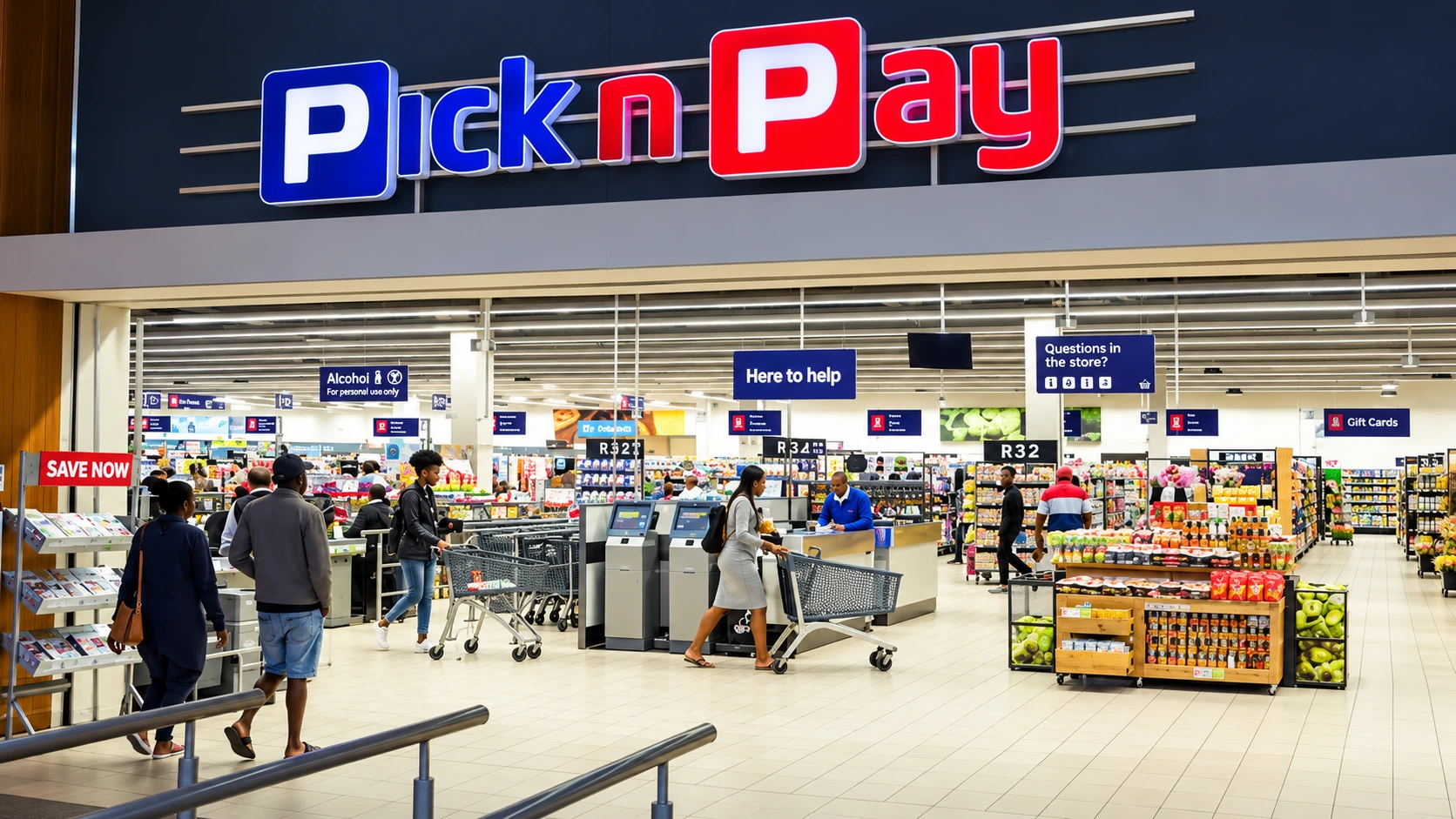
Pick n Pay says the bleeding is slowing. The retailer’s half year losses are smaller than they were a year ago, even though it shut 19 more supermarkets along the way. The pick n pay headline loss interim figure is better, but it’s still a loss, and the company knows it. Management is now pointing to the 2029 financial year as the point where it should finally break even. Let’s walk through what happened in a simple way.
A simple look at the interim numbers
The results cover the six months to 31 August 2026, which is the first half of Pick n Pay’s 2027 financial year. Gross profit climbed 3.9% to R6.4 billion. Good news so far. But the company still ended the period with a headline loss of R299 million.
Now compare that to last year. Back then the loss was R439 million, so this year’s number is 31.9% smaller. The trading loss moved in the same direction. It dropped from R621 million to R516 million, an improvement of 16.9%.
Sales barely moved, by the way. Turnover came in at R36.4 billion, a hair below last year. So the better result didn’t come from shoppers spending much more. It came from the company spending less and running a leaner network.
If numbers make your eyes glaze over, the table below keeps things easy to follow.
| Measure | Six months to 31 Aug 2026 | Six months to 31 Aug 2025 | Change |
|---|---|---|---|
| Turnover | R36.37 billion | R36.39 billion | 0.1% lower |
| Trading loss | R516 million | R621 million | 16.9% better |
| Headline loss | R299 million | R439 million | 31.9% better |
| Headline loss per share | 40.71 cents | 59.77 cents | 31.9% better |
The direction is right. The size of the hole is what worries people.
Why the headline loss per share matters
Investors love this one. Headline loss per share, or HLPS, shows how much of the loss falls on each share. It shrank by 31.9% to 40.71 cents.
Here’s the catch for shareholders. Because the company is losing money, it hasn’t declared a dividend. It also says none is coming until profits return. So if you were hoping for a payout, you’ll be waiting a while. It’s an easy detail to overlook, but it matters if you own the stock.
Company results like these are filed through the Johannesburg Stock Exchange, where investors can check the official announcements for themselves.
Store closures continue
Over the past 12 months, Pick n Pay closed 19 supermarkets. These were stores that weren’t pulling their weight. The network now stands at 520 supermarkets.
The closures are part of a turnaround plan that began in 2024, when the company was declared technically insolvent. That was a dark moment for a brand most South Africans grew up with. Since then, management has been cutting weak stores, trimming costs and trying to rebuild sales.
Nobody enjoys seeing a local store shut its doors. Workers lose routines, and shoppers lose a convenient stop. But the company’s thinking is simple enough. A smaller group of healthy stores beats a big group that keeps losing money.
Online shopping is a bright spot
Not all of the news was heavy. Pick n Pay’s online business grew turnover by 35.4%, which is a big jump. Plenty of South African retailers are seeing the same shift as people get used to ordering from their phones.
The company gave credit to its clothing range on the Pick n Pay ASAP! app. It said the clothing launch on the app did well and came in far ahead of budget. For customers, getting groceries and clothes through one app is pretty easy. For Pick n Pay, it’s a way to grow without building new shops.
A new store labour model
There’s another big change coming inside the stores. Earlier this year, Pick n Pay said it wanted a new store labour model to help get the business back to profit. That process is now done.
The retailer says it reached an agreement with its main labour partners after talking to several unions and other groups. It describes the new model as more flexible, efficient and sustainable. It kicks in on 1 November 2026.
CEO Sean Summers said he was pleased with the outcome. In his view, it gives employees certainty, helps protect jobs and puts the business in a stronger position to compete and grow.
Workers who want to know their rights during changes like this can get simple, reliable guidance from the Department of Employment and Labour.
What management says about the road ahead
Summers told the market that the fundamentals are now in place and are starting to deliver, even with a tough trading climate in South Africa. He also said the company’s own supermarkets had a strong like for like performance, ahead of competitors, with more benefits still to come.
He didn’t pretend the job is finished, though. The company still has to improve the customer experience, grow sales in a steady way and keep fixing operations before it can turn a profit.
The target hasn’t changed: break even in the 2029 financial year. The latest numbers back it up, at least for now. But think about the scale. A trading loss of R516 million in just six months is a lot of ground to make up.
What this means for ordinary shoppers
Most people really only want to know one thing. Will my local store close? The closures so far have hit weaker stores, so busy and well run branches are less likely to be next. But the company hasn’t promised the closing is over, so nobody can say for sure.
You may see more online options as time goes on. The ASAP! app is becoming a bigger part of the business, and clothing is now part of it. If you already order online, that should make life easier. If you like walking the aisles, your usual store should be fine as long as it keeps performing.
The new labour model starts on 1 November, so staffing at stores could look different over time. The company hasn’t shared details on what will change in each branch, so it’s something to watch rather than worry about.
The bigger picture for retail in South Africa
Pick n Pay isn’t fighting this battle alone. Households are stretched, costs keep climbing and supermarkets are competing hard for every rand. It’s a tough place to be a retailer.
In that setting, the pick n pay headline loss interim result tells a useful story. Cost cutting, store closures and online growth are starting to help. But a smaller loss is still a loss, and the company has plenty of work left.
The next set of results will be the real test. If the loss keeps shrinking at this pace, 2029 starts to look believable. If sales stay flat and costs stay high, the road could get much longer.
Key points to remember
Here’s a quick and simple recap:
- The headline loss for the six months was R299 million, down 31.9%.
- The trading loss improved by 16.9% to R516 million.
- Gross profit rose 3.9% to R6.4 billion.
- 19 stores closed in 12 months, leaving 520 supermarkets.
- Online turnover grew by 35.4%.
- The new labour model starts on 1 November 2026.
- There’s no dividend until the company returns to profit.
- The company is aiming to break even in 2029.
Pick n Pay is clearly working hard to fix its business. The numbers are heading the right way, but the finish line is still a good distance off. Shoppers, workers and investors will all be watching to see if it gets there.
About the Author