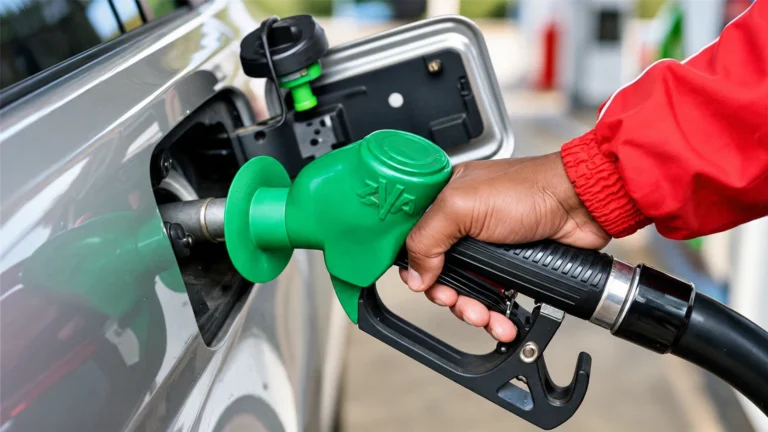
Motorists get a small break at the pumps this week. It is not a big one for petrol drivers, though. The Department of Mineral and Petroleum Resources has confirmed the new fuel price changes, and they take effect on Wednesday, 4 November 2026.
Petrol gets a cut of just one cent per litre. Diesel drivers fare better, with cuts of more than a rand. Here is what the petrol price november announcement means for your wallet.
What changes on 4 November
The November petrol price change is very small. Both 93 and 95 petrol drop by only one cent per litre. You will barely notice it when you fill up.
The diesel price story is better. The 0.05% diesel falls by R1.10 per litre, and the 0.005% diesel falls by R1.20 per litre. These are wholesale figures, so pump prices at your local station can differ.
Other fuels move the other way. Illuminating paraffin rises by R2.75 per litre. LP gas in Gauteng goes up by R1.83 per kg.
Anyone searching for a south africa fuel price drop november headline will find a real drop for diesel. For petrol, it is only a token cut.
Why petrol barely moved
It helps to know what was happening before the announcement. October was a hard month for fuel costs. Global oil prices climbed, and the rand weakened against the US dollar. Data through most of the month pointed to another heavy hike at the pumps.
Then National Treasury stepped in. After calls from different sectors for help, it announced a R10 billion relief package that starts on 4 November. You can read more on the National Treasury website.
The package cuts the general fuel levy for the second time this year. Petrol gets a cut of R1.50 per litre, and diesel gets R3.00 per litre.
That sounds like a lot of relief for petrol, but most of it was cancelled out. The slate levy went up at the same time, and that wiped out the benefit. The result is a one cent cut for petrol.
Diesel drivers still enjoy a clear saving this week.
What pushed costs up
Two main things pushed the cost of fuel higher during the review period.
The first is oil. The average Brent crude price rose from 101 US dollars to 108 US dollars per barrel. The increase came from uncertainty linked to the Middle East conflict, including recent attacks on Saudi Arabia’s infrastructure. High freight and insurance costs also played a part, because of ship to ship transfers.
The second is the rand. It lost ground against the dollar, moving from an average of R16.21 to R16.55. A weaker rand makes imported fuel more expensive. This is easy to see in everyday life, since we buy fuel in dollars.
The numbers show the impact. Higher international product prices added 80.41 cents per litre to the basic fuel price of petrol. For diesel the addition was 94.22 cents per litre, and for illuminating paraffin it was 225.23 cents per litre.
The weaker rand added more on top. It pushed up the basic fuel price by 36.93 cents for petrol, 49.00 cents for diesel and 49.26 cents for illuminating paraffin.
International diesel fuel prices have their own pressures. Supply is tight around the world. Demand usually rises ahead of winter in the Northern Hemisphere. The Russia Ukraine conflict also continues to weigh on the market.
There were some efforts to ease supply. The G7 took steps to boost diesel supply. The United States waived some Russia sanctions, and Russia lifted certain export restrictions. Even so, international diesel prices still rose over the period.
The south african fuel slate levy explained
The south african fuel slate levy is a big part of this month’s story. Many people do not know how it works, so here is a simple explanation.
The slate levy is a tool that helps recover money when fuel costs run ahead of what motorists pay. If fuel recoveries are negative for a while, a balance builds up. That balance is called the slate.
At the end of September 2026, the cumulative slate stood at a negative balance of R15.876 billion for petrol and diesel. Under the Self Adjusting Slate Levy Mechanism, a levy of 135.84 cents per litre will now be included in the price structure for both fuels from 4 November 2026.
That is a jump of 48.18 cents per litre. It was 87.66 cents before. This increase is the main reason the Treasury relief did not lead to a bigger cut for petrol. You can find more on fuel policy on the Department of Mineral and Petroleum Resources site.
New pump prices at a glance
The table below shows the official petrol prices and other fuel prices for inland and coastal areas. Diesel and paraffin figures are wholesale, so your pump price may differ.
Inland
| Fuel | October | November |
|---|---|---|
| 93 Petrol | R29.88 | R29.87 |
| 95 Petrol | R30.25 | R30.24 |
| Diesel 0.05% (wholesale) | R31.95 | R30.85 |
| Diesel 0.005% (wholesale) | R32.80 | R31.60 |
| Illuminating paraffin | R24.47 | R27.22 |
| LP gas (per kg) | R37.81 | R39.64 |
Coastal
| Fuel | October | November |
|---|---|---|
| 93 Petrol | R29.09 | R29.08 |
| 95 Petrol | R29.38 | R29.37 |
| Diesel 0.05% (wholesale) | R31.08 | R29.98 |
| Diesel 0.005% (wholesale) | R32.03 | R30.83 |
| Illuminating paraffin | R23.41 | R26.16 |
| LP gas (per kg) | R34.55 | R36.39 |
| LP gas (Saldanha) | R37.08 | R39.16 |
Inland drivers still pay more than coastal drivers. A litre of 95 petrol costs R30.24 inland and R29.37 at the coast. That gap has not changed much from last month.
What this means for households
For most car owners, the petrol price is almost flat. Your monthly fuel bill should look about the same as it did in October.
Diesel users get a simple win. Truck operators, farmers and anyone running a diesel vehicle will see lower wholesale costs. Whether that reaches shoppers through lower transport costs is another matter. It is too early to say.
Households that use illuminating paraffin or LP gas will feel pressure instead. Paraffin rises by R2.75 per litre, which is a big jump. Many families use paraffin for cooking and heating, so this increase will hurt. LP gas also climbs, and cooking with gas will cost a bit more.
Small habits can help, and they are easy to adopt. Keep your tyres properly inflated. Plan your trips so you drive less. Avoid carrying extra weight in the boot. None of these will change the price, but they can ease the pinch.
The bigger picture
This month shows how many things shape the fuel price you pay. Oil markets, the rand, taxes and levies all play a role. A cut in one place can be cancelled out by an increase somewhere else.
Treasury’s relief was meant to protect motorists from a heavy hike, and it did that. Without it, the slate levy increase and weaker recoveries would have pushed petrol up sharply. A one cent cut is a much better outcome than a big increase.
The outlook for the coming months is hard to predict. Much depends on oil prices and the rand. Both are moving because of events outside South Africa’s control. The slate also remains deeply negative, which means pressure on the levy may continue.
For now, the message is simple. Petrol stays almost where it was, diesel gets real relief, and paraffin and gas users face higher costs. Keep an eye on the next announcement to see whether the trend holds.
About the Author