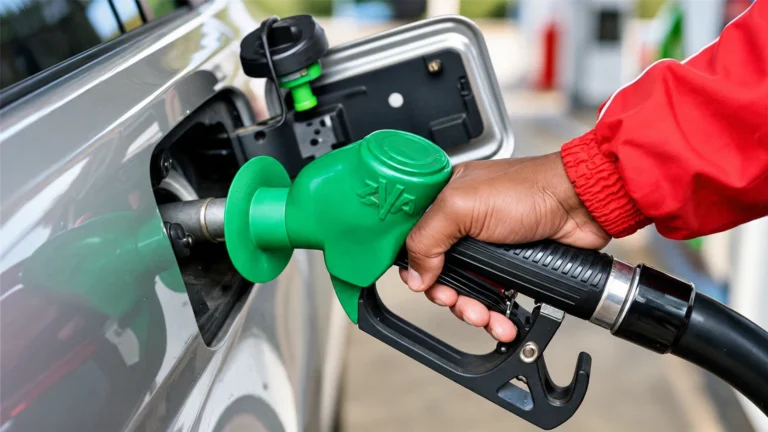
Anyone who fills a tank in this country knows how rough the year has been. So when the final October numbers came in pointing to a proper cut at the pumps, a lot of motorists let out a small sigh of relief. The South Africa fuel price cut for November is bigger than most people were bracing for just a few weeks ago.
But it’s not all smooth driving. Below is what’s changing, why the price you pay will still sting, and why more drivers are looking at LPG as a way out.
What the fuel levy cut means for you
Finance Minister Enoch Godongwana announced the relief in the Medium Term Budget Policy Statement on 21 October. The government is trimming the general fuel levy, but only for a short while. Don’t mistake it for a permanent drop.
The first round kicks in on Wednesday 4 November 2026, which also happens to be the day of the local government elections. A second, smaller round follows from 2 December until 5 January 2027.
| Period | Petrol cut per litre | Diesel cut per litre |
|---|---|---|
| 4 November to 1 December 2026 | R1.50 | R3.00 |
| 2 December 2026 to 5 January 2027 | R1.00 | R1.50 |
Treasury reckons the plan will cost around R10 billion in revenue it won’t collect. What happens after 5 January isn’t decided. Treasury says it will look again and see whether the state can afford to carry on.
We’ve been here before this year. The levy was also cut between April and June. So the government clearly steps in when things get ugly, but nobody should treat it as a long term fix.
Why relief may not bring prices down
The latest Central Energy Fund data tells an interesting story. Normally, when fuel is selling for less than it costs to bring in, motorists should expect a hike. That’s called an under recovery, and it was looking exactly that way for most of October.
At month end, petrol was sitting at an under recovery of R1.01 per litre for 93 and R1.17 for 95. For diesel fuel, it was R1.42 for the 0.05% grade and R1.32 for the 0.005% grade. Left alone, those numbers would have meant higher prices next week.
The levy cut changes the story. It’s big enough to wipe out the hike and then some, which is why the petrol price November 2026 is now expected to land lower than October. Here’s how the inland numbers could look, though the official figures are only confirmed in the days ahead.
| Fuel type | October price (inland) | Expected November price (inland) |
|---|---|---|
| Petrol 93 | R29.88 | R29.39 |
| Petrol 95 | R30.25 | R29.92 |
| Diesel 0.05% | R31.95 | R30.37 |
| Diesel 0.005% | R33.29 | R31.61 |
Diesel users come out better because their cut is double the petrol one. The diesel picture has weakened a bit since the budget, but a drop at the pumps still looks very likely.
Now for the fine print. These projections don’t include the slate levy, which went up to 87.6 cents per litre in October, an increase of 4.4 cents. The slate account was R10.456 billion in the red at the end of August. If that hole gets deeper, the levy will climb again and take a bite out of your savings.
And remember where the cut is coming from. It’s the government propping things up, not the market. Oil is trading above $111 a barrel, and the rand has slipped to roughly R16.60 against the dollar, down from around R16.20. War in the Middle East, tanker attacks near the Strait of Hormuz and the fighting between Russia and Ukraine keep everyone nervous. Winter in the northern hemisphere pushes demand up as well.
So yes, the fuel price November 2026 looks friendlier on paper. But look at the bigger picture. Since the US and Iran war started, petrol prices South Africa wide have gone up by more than R10 per litre, and diesel by nearly R15. Even after next week’s cut, petrol 95 is still about R9.82 higher than before the war, and diesel is about R13.16 higher. That’s a lot of money for a family that drives to work every day.
Why LPG is getting attention
When the pump price keeps hurting, people start asking whether there’s a cheaper way to keep the same car on the road. More and more of them are landing on gas.
The Automotive Remanufacturers’ Association, which sits under the Retail Motor Industry Organisation, has been pushing LPG Autogas. It showed it off at the Automechanika Johannesburg exhibition from 27 to 29 October. LPG stands for liquefied petroleum gas, and in a converted car it works next to the normal petrol system.
What makes it attractive is that you don’t need a new car. A suitable petrol vehicle gets a conversion kit fitted, and then it can run on gas.
The pump prices are what really get people talking. A listing by Drive LP AutoGas shows stations in Gauteng, the Western Cape, KwaZulu Natal and Mpumalanga, charging anywhere from R14.74 per litre inland to R15.90 at the coast.
Some dedicated Autogas stations are cheaper still. Isinkwe Energies says it has 12 of them across KwaZulu Natal, the Western Cape and Gauteng, with prices between R11.30 inland and R12.78 at the coast. Another one is being commissioned in Midrand.
Isinkwe’s managing director, Kyle Hartley, says LPG prices will still move, just not as wildly as petrol and diesel. For anyone trying to plan a monthly budget, that calmer pattern counts for a lot.
How much could you save?
BusinessTech ran the numbers on a Suzuki Dzire, a small car that’s claimed to use 4.9 litres of petrol per 100km. It took the inland price of R30.25 for petrol and compared it with the highest listed LPG price of R15.90.
| Distance driven per month | Estimated monthly saving |
|---|---|
| 250km to 1,000km | R194 to R774 |
| 1,250km to 3,000km | R967 to R2,320 |
The pattern is simple. The more kilometres you cover, the more you save. If you only do short trips, the gain will be small. If you drive a taxi, deliver parcels or spend your days visiting clients, it adds up fast. Keep in mind that petrol will be a little cheaper next week, so the gap between the two fuels may narrow slightly.
The catch: conversion costs and limits
Before you book a workshop, think about the bill. A conversion costs between R17,995 and R33,293, with VAT and fitting included. Your monthly savings have to pay that back first, and if you don’t drive much, that could take a very long time.
Then there are the other hurdles. Not every car can be converted, so you must check yours. Gas stations are still thin on the ground, mostly in a few provinces. The work must be done by a qualified technician, because safety matters when you’re dealing with gas, and you’ll need regular maintenance afterwards.
LPG isn’t pollution free either. Industry figures quoted by the association say it can cut carbon dioxide by up to 21% and fine particles by up to 95%, but your results will depend on the car and how you drive it.
Plenty of people are curious, but fewer follow through. Hartley says only about 30% of enquiries turn into real conversions. The biggest shift is coming from fleet owners, who understood the savings early and are now putting more vehicles on gas, in some cases across the whole country.
Why businesses are paying attention
If you run a company, fuel is one of your biggest costs. When prices jump, someone has to take the hit, and it’s either the business or the customer.
Gina Giani, chief executive of DFSK South Africa, believes fuel costs won’t ease soon and that expecting customers to simply swallow them isn’t a plan. DFSK now sells manufacturer approved LPG conversion kits for its petrol vehicles.
The company shared an example. A C35 panel van drove a 1,200km roadshow using 80 litres of LPG and just a quarter tank of petrol. DFSK says businesses can save 30% to 50% on running costs. Those are the company’s own claims, so any owner should test the numbers on their own vehicles first.
Attie Serfontein, the association’s national director, says LPG gives drivers and businesses one more option for managing costs while moving towards cleaner transport.
Is LPG right for you?
It comes down to a few honest questions. How many kilometres do you drive in a month? The more you drive, the quicker the kit pays for itself. Can your car be converted safely? A qualified fitter can tell you. Is there a gas station on the route you usually take? And can you afford the upfront cost right now?
If most of your answers are yes, get more than one quote before you decide. If you don’t drive much, the cut in petrol and diesel fuel prices next week might be all the help you need for now.
What to do next
For most South Africans, next week brings a welcome but modest cut, not a big drop. Diesel users gain the most, while petrol 95 drivers will still pay close to R30 per litre. The slate levy, the oil price and the rand can all shift the final numbers before 4 November, so don’t be surprised if they move a little.
You can follow official updates on the National Treasury website at treasury.gov.za, and keep an eye on the Central Energy Fund for the data behind each monthly adjustment.
LPG could work well for high mileage drivers and fleet owners. It’s no magic fix, and it won’t suit everyone. But as long as fuel stays expensive, more people will keep asking the same thing: is there a smarter way to fill up?
About the Author