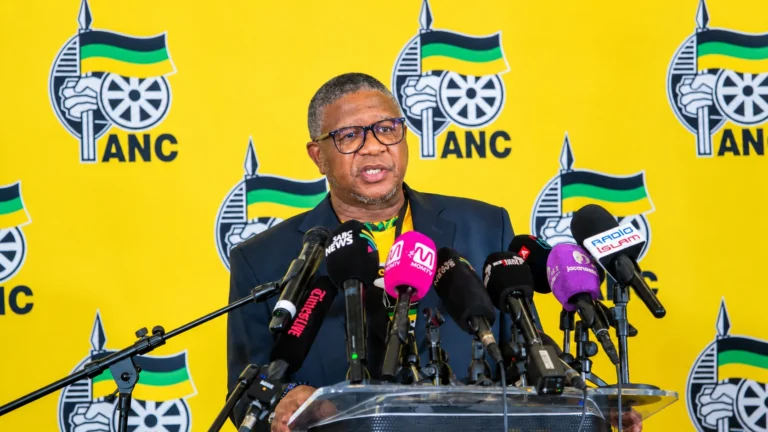

The Constitutional Court has ruled in the ANC’s favour, and the fallout is already shaking the Government of National Unity. Party Secretary General fikile mbalula says the ANC must now sit down and rethink the DA’s role in the GNU. The anc municipal election ballot dispute has turned into a bigger political fight than many expected.
What the Constitutional Court decided
On Thursday, 15 October 2026, the Constitutional Court gave the ANC permission to appeal a ruling by the Electoral Court. That earlier ruling was handed down last month. The apex court then set it aside.
The court also gave a clear instruction to the iec. The Electoral Commission must take the steps needed to place the party’s candidate lists and nominations on the ballot. This means the ANC can contest the local government elections on 4 November in the affected areas.
It is a simple outcome with large consequences. The party had been facing the loss of hundreds of candidates in several municipalities. Now it gets to stand.
How the anc municipal election ballot dispute started
The trouble began on 28 August. That was the deadline for parties to finish submitting their candidate lists on the Electoral Commission’s online system. The deadline was 5pm.
According to court papers reported by the media, the ANC captured its candidate details on the system. But it did not click the final “submit as final” button before the cut off. The iec said this meant the lists were not properly submitted.
The ANC saw it differently. It argued that uploading the names showed clear intent to field those candidates. It also argued that software should not override the law or the rights of citizens. The party said it was not asking for special treatment.
At least 181 candidates were affected. The lists in question covered six municipalities across KwaZulu-Natal, the Free State and the Eastern Cape. They include Port St Johns, Ngquza Hill, Walter Sisulu, Sundays River Valley, uMshwathi and Mangaung.
Here is a quick look at how things moved:
| Date | What happened |
|---|---|
| 28 August | Deadline passes without the ANC finalising its lists |
| September | Electoral Court rules in favour of the IEC |
| 12 October | ANC argues its case at the Constitutional Court |
| 15 October | Constitutional Court rules in the ANC’s favour |
| 4 November | Local government elections |
Mbalula questions the DA’s commitment
Soon after the judgment, mbalula turned his attention to the DA. The DA had challenged the ANC’s nominations in court. According to Mbalula, that move raises hard questions.
He pointed to the founding statement of intent of the GNU. In his view, every partner in the unity government is bound to promote the constitutional framework of the Republic. He said arguing in court against the enfranchisement of hundreds of thousands of South Africans “does not sit easily” with that promise.
He also made it clear that talks are coming. The movement, he said, will have to sit down and discuss these matters. He did not announce any decision. He did not say the DA would be removed. He only said the ANC needs to review the relationship.
That is an important detail. A review is not an exit. But in coalition politics, even a review can change the mood between partners.
The DA hits back
The DA was quick to respond. Helen Zille, the party’s Johannesburg mayoral candidate, said the judgment “makes no sense”. She argued that it suggests the rules do not apply to the ANC.
Zille also raised a practical worry. She said most ballot papers have already been printed. In her view, the ruling could place the Electoral Commission under heavy logistical pressure and create chaos.
This is not a new argument from the DA. Earlier in the week, the party warned that a win for the ANC could open the door for others. It said other parties that did not finalise their lists in August might also ask to be added. The DA said this could cause “absolute chaos” so close to election day.
These are fair concerns for voters to think about. Printing, distributing and checking ballot papers takes time. With the vote only weeks away, every day counts.
What this means for voters
For ordinary South Africans, the key point is easy to explain. If you live in one of the six affected municipalities and support the ANC, you should now see the party’s candidates on your ballot.
If you support another party, your ballot should still work the same way. The Electoral Commission has not said otherwise. It is also worth remembering that the iec has been busy with other election tasks. Reports this week said it approved more than 2.6 million special votes for the local polls.
Here are some simple steps voters can take:
- Check your registration details on the official IEC website.
- Confirm your voting station before election day.
- Bring your valid ID on the day.
- Follow updates from the Electoral Commission for any changes to ballot arrangements.
You can find voter information on the Electoral Commission of South Africa website. Many people also follow sabc news and other broadcasters for live election updates, so it helps to check more than one trusted source.
The bigger political picture
The GNU brought the ANC and the DA together as partners after the 2024 national elections. Since then, the two parties have often disagreed in public. Still, the arrangement has held.
Now the court fight has added fresh tension. The ANC feels it was challenged on a technical point at a time when its voters were at stake. The DA feels the rules should be applied the same way to every party.
Both sides have a case that many South Africans will understand. One side speaks about voting rights and fairness to voters. The other speaks about rules, deadlines and order.
It will not be easy to settle this quickly. The ANC has promised internal talks. The DA has not changed its view of the judgment. Meanwhile, the election date is fixed.
What to watch next
Several things are worth following over the coming days.
- The IEC’s next steps. The Electoral Commission must now act on the court order. How it adjusts ballots and lists will matter.
- Any reaction from other parties. If other groups ask for the same treatment, the picture could change.
- ANC talks on the GNU. Mbalula has promised discussion. The outcome of those talks will shape the unity government.
- Voter turnout. After weeks of legal drama, many people will be watching to see if it affects how South Africans vote.
For official information on the judgment and the court’s work, readers can visit the Constitutional Court of South Africa website.
Final thoughts
The anc municipal election ballot dispute is now settled in court, but not in politics. The Constitutional Court has opened the door for the ANC to contest the November polls. At the same time, fikile mbalula has opened a new debate about the DA and the GNU.
For now, the facts are simple. The ANC will be on the ballot. The iec must make it happen. And the ruling party says it will review its working relationship with the DA.
What happens next will depend on how both parties handle the weeks ahead. Voters will be watching closely.
About the Author