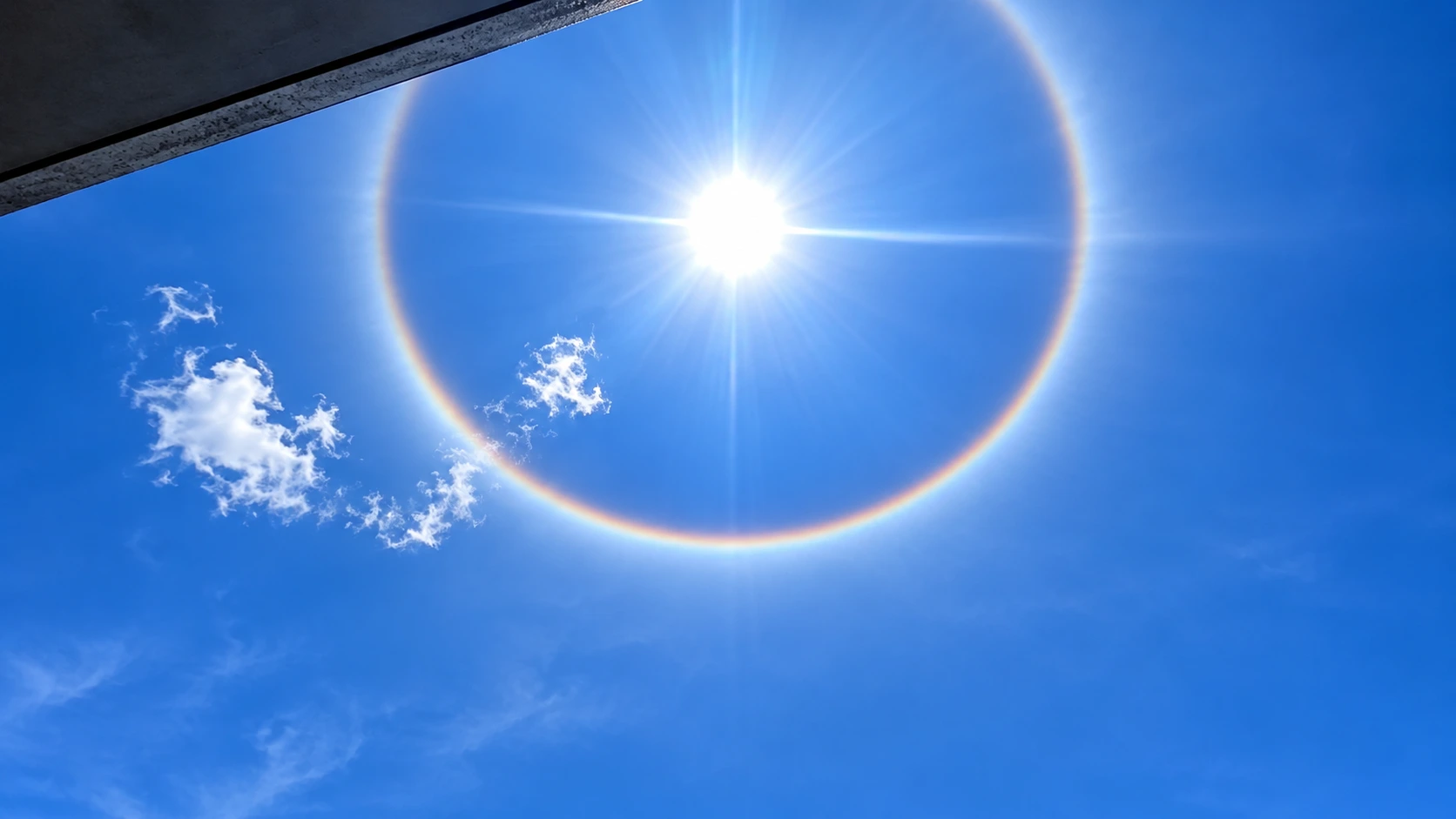
Many people looked up on Monday morning and saw a bright, round ring of light around the sun. It was a solar halo, and it appeared over parts of Gauteng and North West. If you searched for 16 november 2026 sun on your phone, the answer is simple. Tiny ice crystals high in the sky bent the sunlight, and the ring was harmless.
This article keeps things easy to follow. It covers where the sun halo in South Africa was seen and what the South African Weather Service (SAWS) said. It also answers common questions, such as what is sun halo and why some people talk about a rainbow around the sun.
Where the sun halo was seen
The sun halo today was reported in Johannesburg, Pretoria, Hartbeespoort and Rustenburg. Residents in these areas woke up to the sun today looking very different from usual. A clear circle of light surrounded it, like a giant glowing ring.
The ring is called a 22 degree solar halo. It is a simple idea once you know the cause, but it is not something most people see every day. You need the right clouds and the right light. You also need someone to look up at the right moment.
Photos from the morning show the ring around the sun clearly. Many residents stopped to look, and some shared the sight with friends and family. If you missed it, this easy guide explains what happened.
What the weather service said
SAWS forecaster Lehlohonolo Thobela explained the cause. He said the halo came after a night of thunderstorms in parts of Gauteng. There was a lot of lightning and thunder, and some areas had heavy downpours. By morning, residents woke up to a bright, circular band of light around the sun.
Thobela said a halo forms when sunlight passes through hexagonal ice crystals in high cirrus clouds. Hexagonal just means six sided. The crystals bend the light, and this bending is called refraction. The result is a ring about 22 degrees from the sun.
That is the whole story in an easy nutshell. Sunlight meets ice, the ice bends the light, and we see a ring.
What is solar halo? A simple explanation
So, what is solar halo? It is a ring of light around the sun, or sometimes the moon, caused by ice in the atmosphere. Here is an easy way to picture it.
Cirrus clouds sit very high up, where the air is far below freezing. These thin, wispy clouds are made of ice and not water drops. Many of the crystals are tiny six sided columns or plates. When sunlight enters one, it bends and leaves at an angle.
Millions of crystals float in the sky, all facing different ways. The bent light spreads out and forms a full circle. The angle is about 22 degrees, which is where the name comes from.
This also answers what causes sun halo. The ingredients are sunlight, ice crystals and a little geometry. It is simple when you take it step by step.
Some people use other names for it, such as halo sun, the sun halo or sun ring. They all mean the same thing. The shorter word halo is also common in weather talk.
Ring around the sun meaning: does it mean rain?
Many people ask about the ring around the sun meaning. Some old sayings say a ring means rain is on the way. There is a small grain of truth in this, but the simple answer is not a clear yes.
The World Meteorological Organisation (WMO) says 22 degree halos are among the most commonly seen optical effects in the sky. Halos can appear ahead of approaching weather systems, but their appearance does not necessarily mean rain is about to fall.
Cirrus clouds can arrive before a change in the weather. They can also drift over for other reasons. So a halo is a nice clue, but it is not a promise.
On the day, SAWS had forecast partly cloudy and warm conditions in Gauteng. It also expected scattered afternoon showers and thundershowers. That forecast was easy to check, and it did not depend on the halo.
If you ask why is there a ring around the sun today, the answer is cirrus cloud full of ice crystals. That is what what is the ring around the sun comes down to. The earlier storms in Gauteng were part of the weather picture that morning.
Is it a rainbow around the sun?
Some people describe the sight as a rainbow around the sun. It is an understandable comparison, but the two are different. A rainbow needs raindrops, and you see it with the sun behind you. A halo needs ice crystals, and it forms right around the sun.
According to the WMO, 22 degree halos usually look white. They can show a faint red colour along the inner edge. The red edge appears because red light bends the least as it passes through the crystals.
Here is an easy table that shows the main differences.
| Feature | Solar halo | Rainbow |
|---|---|---|
| What makes it | Ice crystals in high cirrus clouds | Water droplets in the air |
| Where you see it | In a ring around the sun | On the side opposite the sun |
| Colour | Mostly white, with faint red inside | A full range of colours |
| Shape | A circle around the sun | A curved arc |
So the south africa sun ring phenomenon seen on Monday was a true halo and not a rainbow. It is a simple difference once you know what to look for.
Joburg sun halo phenomenon explained in plain words
For readers who want the joburg sun halo phenomenon explained in a few lines, here it is. Storms moved through Gauteng overnight. By morning, thin cirrus clouds high above held tiny ice crystals. Sunlight passed through those crystals and bent into a ring.
That is all there is to it. It is easy to understand, and it is a good reminder that the sky is full of science. The same effect can happen anywhere cirrus clouds are present. This is why people in more than one province saw it.
Is the sun acting strangely?
Some people wondered whether the ring had something to do with the sun itself. Here, the facts are simple. The South African National Space Agency (SANSA) reported low solar activity on Monday. It recorded no significant solar flares in the preceding 24 hours.
The halo is an atmospheric effect, so it is unrelated to changes in solar activity. In other words, the sun was not doing anything unusual. The change was in our own sky. You can follow space weather updates on the SANSA website.
Stay safe when you look at the sun
A halo is lovely, but safety comes first. Looking directly at the sun can cause permanent eye damage. This is true even when the sun has a pretty ring around it, and even when thin clouds seem to soften the glare.
Here are a few easy tips.
- Do not stare at the sun, even for a short time.
- Use a building, a tree or a wall to block the bright disc if you want to see the ring.
- Take a photo and enjoy it on your screen instead.
- Keep children away from direct sun gazing and explain why.
These steps are simple, and they protect your eyes while you enjoy the view.
Can you see a halo again?
Yes, you can. A sun halo south africa sighting can happen on any day when thin cirrus clouds cover the sky. The ring is often brief, because clouds move and change quickly. A halo can also form around the moon at night, which is a lovely sight.
If you want to spot solar halo today or ring around the sun today again, look for high, thin and wispy clouds. Keep your eyes off the bright disc itself, as explained above. It also helps to check the daily forecast from the South African Weather Service, which shares warnings and updates for every province.
A quick note on search terms may help too. People type many phrases, such as today sun, sun today, ring around sun or sun halo in south africa. They all lead to the same easy answer: ice crystals in cirrus clouds bending sunlight.
The bottom line
The halo seen over Gauteng and North West on Monday was a 22 degree solar halo. Hexagonal ice crystals in high cirrus clouds bent the sunlight, as SAWS explained. It followed a stormy night in Gauteng, and it was reported in Johannesburg, Pretoria, Hartbeespoort and Rustenburg.
The halo does not mean rain is certain. It is also not linked to solar activity, which SANSA described as low. It is simple science, and it is also a beautiful sight.
Next time you see a ring in the sky, you will know the answer. Enjoy it safely, and remember to protect your eyes. If you spotted the halo yourself, tell your friends about it. It is an easy way to share a little wonder from the South African sky.
About the Author