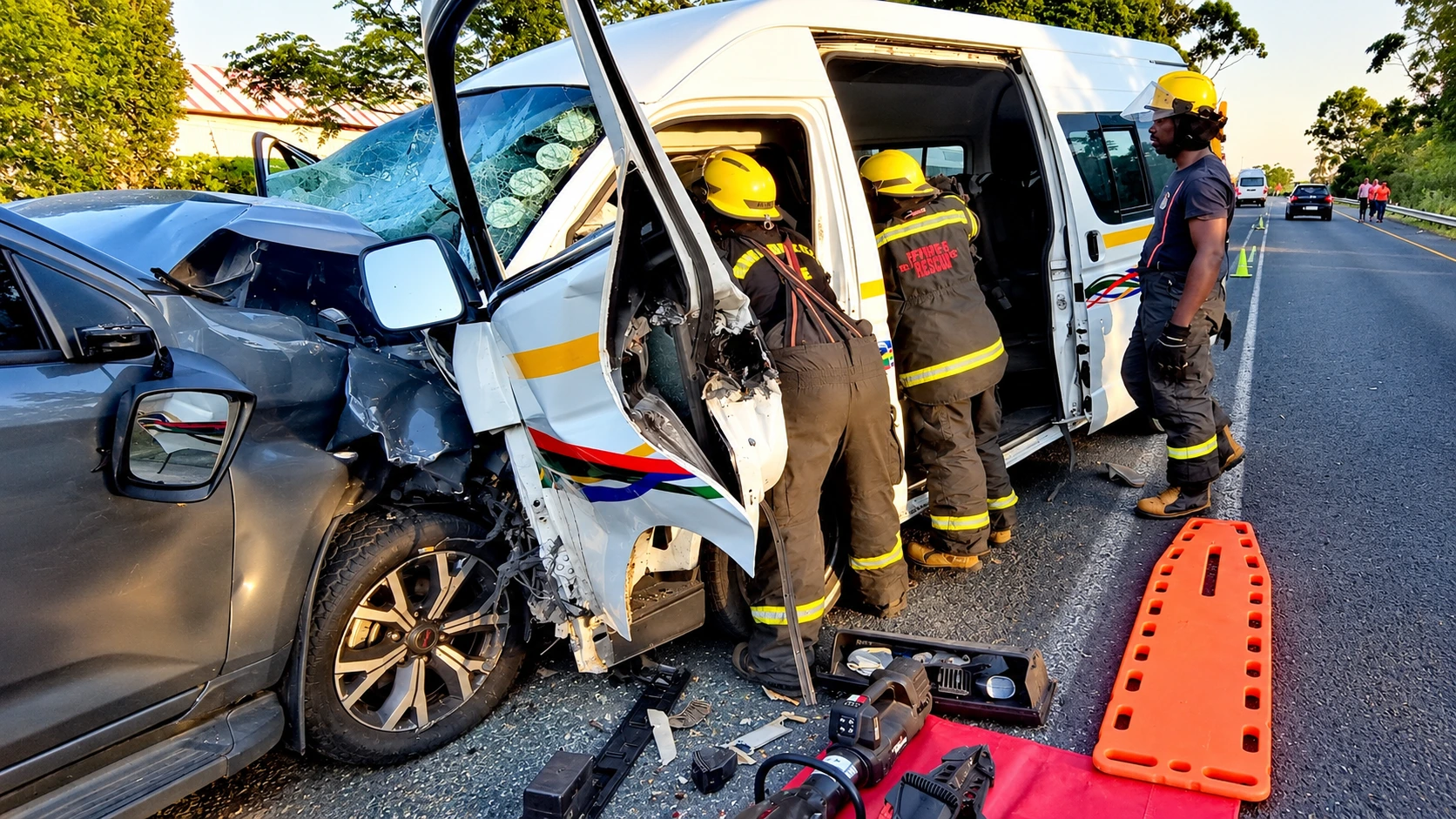
Seven people were hurt in a head-on collision on Ballito Drive in Ballito on Sunday morning, 18 October 2026. A taxi and a bakkie were involved, and one person had to be cut out of the taxi by rescuers.
What happened on Ballito Drive
The call came in early. IPSS Medical Rescue was told about a crash on Ballito Drive, and paramedics headed out. What they found was a taxi and a bakkie that had slammed into each other, nose to nose.
Seven people had injuries. Some were serious, some were minor. The crews had no time to waste, so they went from patient to patient and decided who needed help first. That’s called triage. The idea is simple: the most critical person gets attention before anyone else.
One person trapped inside the taxi
One of the taxi’s occupants was stuck. There was no way out without help.
The KwaDukuza Fire Department was called to the scene, and firefighters got the person out. That sort of rescue is never easy. Metal has to be moved carefully, and one wrong push can make an injury worse. It takes trained people who know what they’re doing.
Six patients stabilised before the trip to hospital
Six patients were seriously hurt. Paramedics didn’t just load them up and go. They stabilised each person on the spot first.
What that means depends on the patient. It could be stopping bleeding, keeping the neck still, helping someone breathe, or easing pain. The goal is to get a person steady enough to survive the drive.
Once that was done, the six were taken to appropriate hospitals. Advanced Life Support paramedics from IPSS Medical Rescue travelled with them, and these paramedics can give a higher level of care than a standard ambulance crew.
The seventh patient had minor injuries and went to a nearby clinic with EMRS.
A quick summary of the response
It’s easy to lose track of who did what in a scene like this, so here it is in a simple table.
| Role | Who responded | What they did |
|---|---|---|
| Medical care | IPSS Medical Rescue | Treated patients and stabilised six seriously injured people |
| Rescue | KwaDukuza Fire Department | Freed the person trapped in the taxi |
| Clinic transport | EMRS | Took the patient with minor injuries to a nearby clinic |
What we still do not know
Not much beyond the above, really. Nobody has said what caused the head-on collision. We don’t know how the two vehicles ended up facing each other in the same lane. The ages of the injured haven’t been shared, and there’s no word yet on how each patient is doing.
Until police or traffic officers say more, guessing helps no one. Rumours spread fast on WhatsApp and Facebook, and families waiting for news don’t need that on top of everything else. If you saw the crash and think you can help, speak to the local police or the traffic authorities in your area.
Why a head-on collision is so dangerous
A head-on collision is about as bad as road crashes get. Two vehicles are moving in opposite directions, so the impact doesn’t just hit one of them. Both take the full force, and the people inside get thrown around hard.
Add a taxi to the mix and it gets worse, because taxis often carry a full load. More passengers means more people at risk in a single crash. Bakkies are part of everyday life here too. Plenty of us use them for work, for family trips, for hauling things. When a bakkie and a taxi meet like this, both vehicles can end up with hurt people inside.
Simple ways drivers can lower the risk
You can’t control the road, but you can control what you do on it. A few habits are easy and cost nothing.
Keep to your lane. Drifting over the line, even for a second, is all it takes. Don’t overtake unless you can see well ahead, because a gap that looks fine can vanish before you’ve finished the move. Ease off on bends, on hills and on busy town roads. Less speed gives you more time to think.
Leave your phone alone while you drive. One glance at the screen is a glance away from the road. And if you’re tired, don’t drive. Tiredness slows you down more than you’d believe, and you usually only notice when it’s too late. A quick look at your tyres and brakes every now and then is a simple habit that pays off.
Passengers have a say too. If your driver is flying down the road or overtaking on blind rises, tell them to slow down. And if your seat has a belt, put it on. It takes two seconds.
What to do if you come across a crash
Most of us feel the urge to rush in. That’s a good instinct, but a calm head helps more.
Pull over well away from the wreckage and put your hazards on. Phone for help right away and give the exact spot, plus how many people look hurt. Don’t pull injured people out of their vehicles unless there’s real danger, like a fire. Someone with a neck or back injury can be hurt badly by being moved. Leave room on the road so ambulances and fire trucks can get through, and listen to the emergency operator.
It’s a good idea to save emergency numbers on your phone before you ever need them. Dialling 112 from a cellphone in South Africa connects you to emergency services. It’s an easy thing to remember, and it can save minutes that matter.
Where to find official road safety information
If you want to read more about road rules and safety campaigns, the Road Traffic Management Corporation is a good place to start. It works on road safety and traffic management across the country. The Department of Transport also puts out information on transport policy and road safety programmes.
Final thoughts
One minute it’s a normal Sunday morning drive, and the next there’s a head-on collision and seven people need help. That’s how quickly things can change on the road.
Credit goes to IPSS Medical Rescue, the KwaDukuza Fire Department and EMRS. Between them, every patient got care and was taken on for further treatment. We wish everyone who was hurt a full recovery.
And for the rest of us, the lesson is the same as always. Slow down, stay in your lane, and get home. It really is that simple.
About the Author