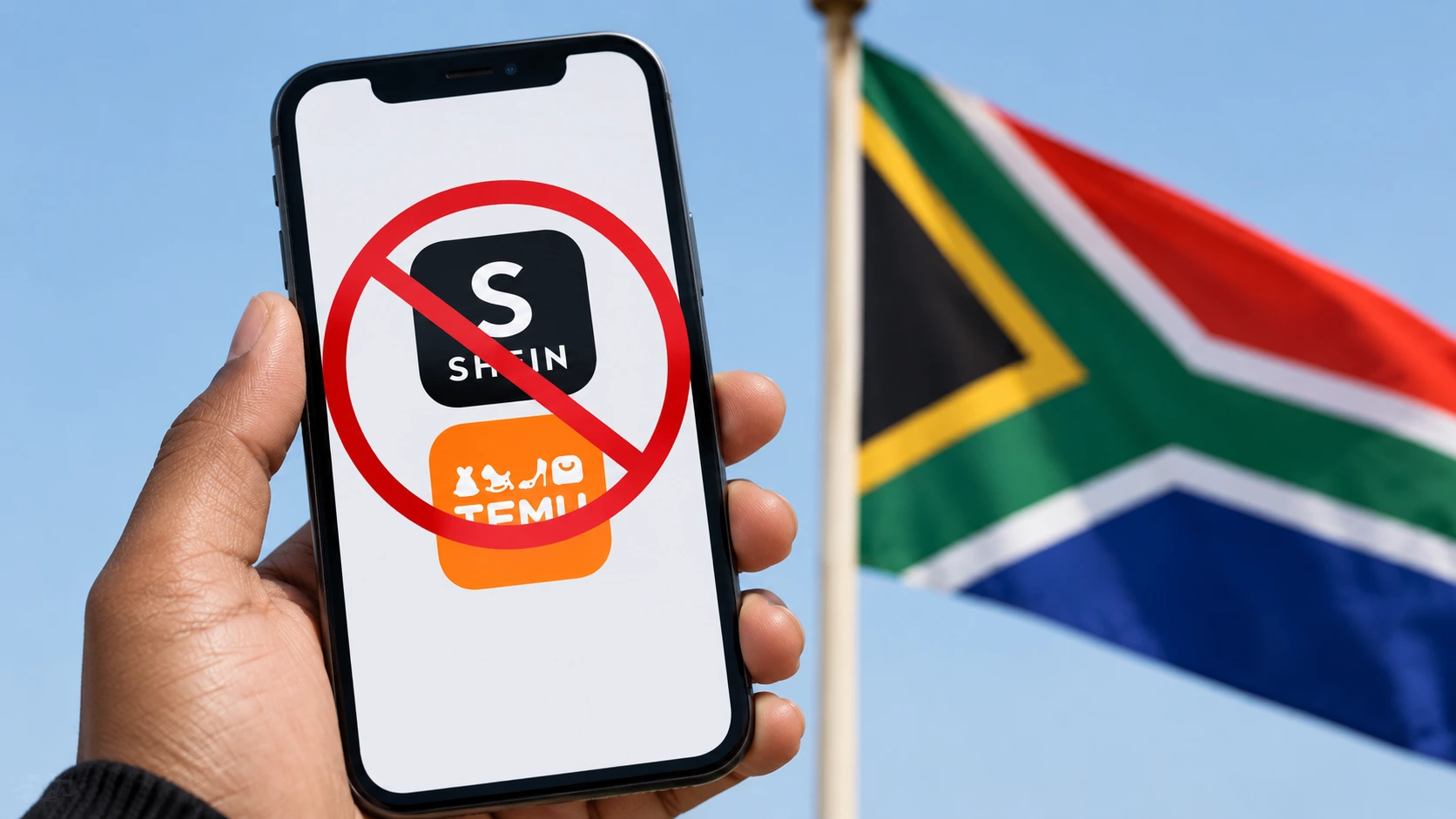
Online shopping has made fashion very easy. A few taps on your phone and a parcel is on its way. But one of the country’s biggest labour groups says this easy access comes at a cost to local workers. The Congress of South African Trade Unions (COSATU) now wants to ban Shein and Temu in South Africa. Here is a simple guide to what was decided, why unions are worried, and what others in the industry are saying.
What COSATU has decided
At its 15th national congress, COSATU delegates backed a resolution to campaign against the two offshore online shopping giants. The idea did not start there. The Southern African Clothing and Textile Workers’ Union (SACTWU) had earlier recommended that the platforms be banned.
The federation says its aim is simple. It wants shoppers to back local businesses, which could then help create jobs. For COSATU, this is about protecting local manufacturing and retail workers from the pressure these platforms put on them.
How Shein and Temu grew so quickly
Both platforms have become hugely popular in South Africa. Their low prices and aggressive marketing have won over many shoppers. Shein arrived first, in 2020. Temu followed in 2024.
A 2025 Reuters report said the two companies held about 3.6% of the local retail market. Their combined sales came to roughly R7.3 billion in the year before. Reuters also noted that sharp pricing, smart marketing and tax loopholes gave them an early edge over local retailers.
Both companies were founded in China and still run large manufacturing operations there. Their corporate structures have since spread across the world.
The jobs argument
Unions often point to a 2025 study by the Localisation Support Fund (LSF). It found that global online retailers are a threat to South African manufacturing jobs. The numbers for 2020 to 2024 are easy to follow in the table below.
| What was measured | Estimate (2020 to 2024) |
|---|---|
| Lost local manufacturing sales | R960 million |
| Manufacturing jobs linked to those losses | 2,818 |
| Retail jobs displaced | 5,282 |
The study also looked ahead. In its worst case scenario, more than 34 000 jobs in the clothing and textile sector could be displaced by the end of this decade. These are estimates from one study. They show why unions are worried, but they are not a final count.
Retailers urge caution
Not everyone agrees that a ban is the answer. Michael Lawrence, executive director of the National Clothing Retail Federation, spoke about the issue on CapeTalk. He said government should look much more closely at how online retailers operate in the country.
Lawrence described a ban as a one dimensional response to a much bigger problem. He said a ban could work in some ways, but it is not an ideal fix. He also worried that blocking the platforms outright could discourage competition in the retail sector.
In other words, the retail federation shares some of the concern, but it wants a more careful plan. It is easy to see why. Shutting out two big players might protect some jobs, but it could also limit choice.
Tax loopholes and the role of SARS
Tax is a big part of this debate. In the past, low value imports did not attract Value Added Tax (VAT). That changed in August 2024, when the South African Revenue Service (SARS) said VAT would apply to imports worth less than R500.
SARS said at the time that it had noted legitimate concerns. These involved importers, especially of clothing bought through ecommerce, who were not paying the required customs duties and VAT. If you want a simple overview of how import rules work, the SARS website is a good place to start.
Even so, Lawrence is not convinced. He said he is still uncomfortable that the closing of these loopholes has been effective. He questioned whether ecommerce companies are paying the correct amount of tax on the goods they bring in. Whether the new rules work in practice is still an open question.
Why this matters to everyday South Africans
This story is not only about big companies and unions. It touches ordinary households in two ways.
First, there are jobs. The clothing and textile sector supports many families. If the LSF estimates are close to the truth, thousands of workers could be affected over the next few years.
Second, there is price. Many shoppers turn to Shein and Temu because the prices fit tight budgets. A ban would change that easy option for people who rely on it. That is why the debate does not have a simple answer.
What happens next
For now, the call to ban Shein and Temu is a campaign by unions. The reports do not mention any government decision on the matter. That means shoppers can still use both platforms, and nothing has changed in law.
Three simple questions are likely to shape the debate:
- Can SARS collect the right tax on every parcel that comes in?
- Would a ban protect jobs, or only reduce choice for shoppers?
- Can local producers match the prices that many people now expect?
Lawrence’s view suggests that tighter rules and better enforcement may be a more balanced path than a full ban. Unions see it differently. They say a ban is the easy and direct way to protect local work.
The bottom line
The push to ban Shein and Temu in South Africa has put a hard question on the table. How do you protect local manufacturing and retail jobs while keeping prices fair for shoppers? COSATU and SACTWU say a ban is the answer. The National Clothing Retail Federation says a ban alone is too narrow and that tax enforcement matters just as much.
The next steps will depend on how government responds and on whether the tax rules introduced by SARS actually work. Until then, the debate is likely to continue.
About the Author